The compliance rules facing UK organisations tightened faster than most of us expected this year. Boards are now expected to show not only that checks were completed at onboarding, but that customers, suppliers, employees, contractors and other third parties are monitored throughout the relationship.
Last year, I said legislation on risk monitoring, supply chains, fraud monitoring and the risk-based approach would get tighter. I based that call on the direction regulators were already moving in and on the fraud and insolvency trends sitting in the data we work with every day. In 2026, that became reality for organisations of every size - across governance, compliance and risk, at both board and staff level.
How well do you really know the people and businesses your organisation relies on as ownership changes, finances tighten and new risks appear? If you can’t spot change and show what you did about it, you face fines, personal liability for leaders or even prosecution.
From this year, under Provision 29 of the UK Corporate Governance Code, premium listed boards will need to declare in the annual report whether their material controls worked at the balance sheet date. That means the controls over risks like these now must be identified, operated and evidenced.
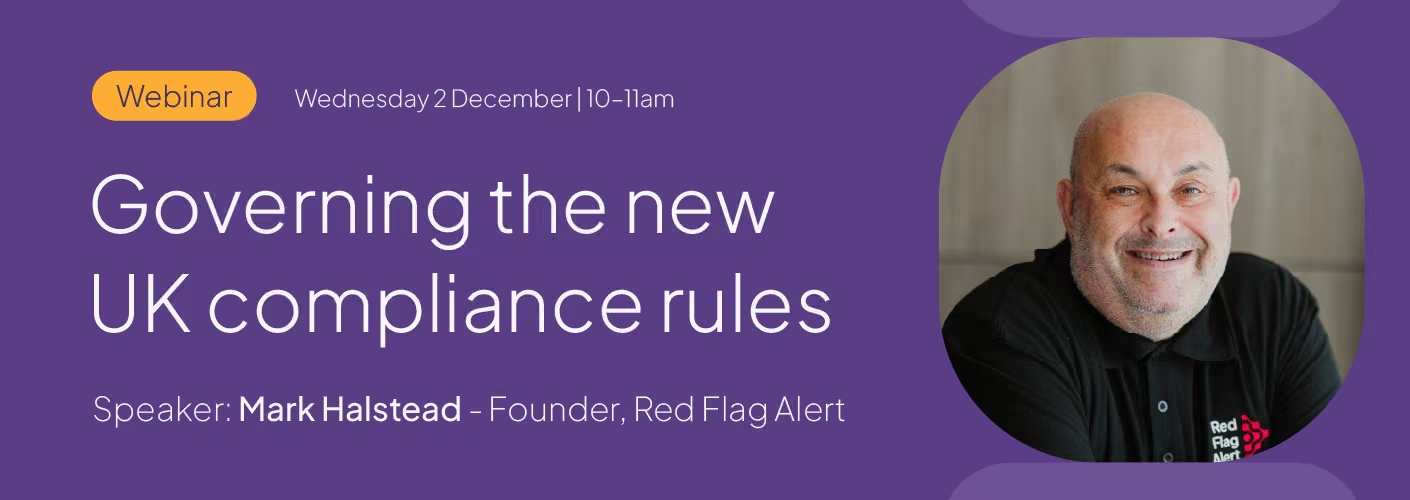
I’m hosting a webinar on 2 December to walk through what these changes mean for your board and where to start. In this article, I’ll set the scene so you know what’s changed, which rules are already in force and what to do first.
What changed in 2026?
In 2026, several areas of compliance law that had previously been signalled or recommended became legal requirements. The key theme is proof that you keep checking your risks on an ongoing basis, not just when you first take on a customer, supplier or employee.
Each of these changes can create a material risk to your business (fines, personal liability, prosecution) so each belongs in your risk register and in the set of controls your board scrutinises under Provision 29.
The main changes you need to know about are as follows:
- A senior manager’s crime can now make your whole organisation guilty too.
Section 250 of the Crime and Policing Act 2026 came into force on 29 June 2026. If a senior manager commits any criminal offence under UK law while acting within their actual or apparent scope of authority, the organisation is treated as having committed that offence as well, whatever its size. The range of offences is wide, including fraud, bribery, money laundering, data protection, computer misuse and more. There’s no general reasonable-procedures defence under section 250, and a prosecution is exactly the kind of event that would force disclosure in your annual report.
- Preventing fraud is now a board-level responsibility.
Under the Economic Crime and Corporate Transparency Act (ECCTA), the failure-to-prevent-fraud offence has applied to large organisations since 1 September 2025. You count as large if you meet two of these three: more than 250 employees, £54m turnover or £27m in assets. If someone connected to your business commits fraud intending to benefit you or your clients, you’re liable unless you can prove you had reasonable procedures to prevent it (the Home Office’s six guiding principles guide that defence, but the guidance is not a safe harbour). Alongside ECCTA sit the Bribery Act 2010, the Criminal Finances Act 2017 (tax evasion), the Procurement Act 2023, and expanded duties covering supply-chain risk, customer and staff due diligence, sanctions and KYC/enhanced vetting.
- AML checks must now continue after onboarding.
HMRC expects you to assess risk, keep monitoring your customers and keep records, all well beyond the initial checks. The expanded guidance is explicit, requiring you to prove your controls work in practice. Both HMRC and the FCA have been issuing substantial AML fines in recent years, and enforcement activity is increasing. The FCA has also been announced as the single AML supervisor for legal and accountancy firms, replacing the professional bodies that currently oversee them.
- Right to Work checks now apply across your whole workforce, not just employees.
From 1 October 2026, you must check workers, individual subcontractors and people hired through online matching services, as well as employees. The civil penalty is up to £60,000 for each illegal worker. The Fair Work Agency also launched in April 2026 as the single body enforcing employment rights. Digital identity verification confirms identity only - it is not, on its own, a Right to Work check. Employers of all sizes must now keep a completed register of Right to Work checks, and the burden sits with the company at the top of the supply chain.
- Businesses in a supply chain can now be held personally liable for tax that goes missing.
Since 6 April 2026, HMRC’s Construction Industry Scheme has used a “knew or should have known” test. If HMRC decides you knew, or should have known, about a problem, you can immediately lose the gross payment status that lets you be paid without tax deducted. You can’t reapply for five years, you can be held liable for tax lost elsewhere in the chain and you can face penalties of up to 30% of the lost tax. Those penalties can fall on the business or on its officers personally.
I’m hosting a webinar on 2 December to walk through what these changes mean for your board and where to start.
Register TodayWhat can you do about it?
Put simply, the law now expects you to keep knowing who you deal with long after the first check. So how do you govern that in practice? The approach is to treat each change as a material compliance risk, then put identifiable, evidenced controls over it.
You can work through it in this order:
- Name and assess the risks first.
Start from the broad principal risk (“failure to comply with relevant laws and regulations”) and break it down into each of the five changes above. Use your existing risk appetite and impact/likelihood criteria to decide which of these are genuinely material, because controls must be attributed to the specific risk element they address.
- Assign a control to each risk.
For each one, be clear which risk the control addresses, what its objective is and what activities make it up. In practice that means deciding who runs verification and screening at onboarding, who monitors relationships afterwards, who maps senior-manager roles, who holds delegated authority in writing, who gets risk-based training and where concerns get escalated.
- Decide which controls are material.
You can work this out by asking yourself, “If this control failed and the risk happened, would we have to alert a regulator, disclose it in the annual report or spend serious management time fixing it?” If yes, those are your material controls. There are no prescribed numbers, and it’s fine to class other important controls as “key” rather than material - that keeps the approach proportionate.
- Make your committee or board review a control.
A risk or compliance committee can be the material control over these risks, but only if it’s precise and authoritative. Its terms of reference should say which risks it covers, what it actually does, how often it meets, what triggers action, what it can decide and that its members are experienced enough to decide. It must also be clear how the review is evidenced.
- Keep hold of the proof.
For any control you rely on as material (especially committee or board-level ones) retain evidence that it really operated. This can include minutes, action logs, monitoring reports, digital audit trails, etc. Make sure the underlying data is complete and accurate before you conclude that the control worked.
- Prepare for the Provision 29 declaration and the audit.
From 2026, premium listed boards must declare in the annual report whether material controls worked at the balance sheet date and describe any that didn’t. In my experience, auditors and regulators expect the same evidence from everyone else, so be ready either way.
Across all five changes, the common thread is evidence. You need to know who you employ, who you do business with, who owns those businesses and whether the risks have changed since you last checked, and proof that you followed your own procedures.
This is where Red Flag Alert can help. We bring together business verification, beneficial ownership analysis, identity verification, and screening for politically exposed persons, sanctions and adverse media. We also provide ongoing alerts across your customers, suppliers and partners, with a digital audit trail behind every decision. That gives you the kind of evidence that makes a control testable. To be clear, our checks support your third-party risk controls, but they don’t by themselves prevent corporate criminal liability or provide a defence under section 250, and no platform can.
Join our free webinar on 2 December to learn more
I’ll be hosting a free webinar on Wednesday 2 December at 10am, using the same material I’ve just rolled out in our internal staff training. We’ll go through each of these changes, explain what they mean for how you run your organisation and show you how to map them to your material risks and controls. Several of these rules are already in force, so the time to prepare is now.